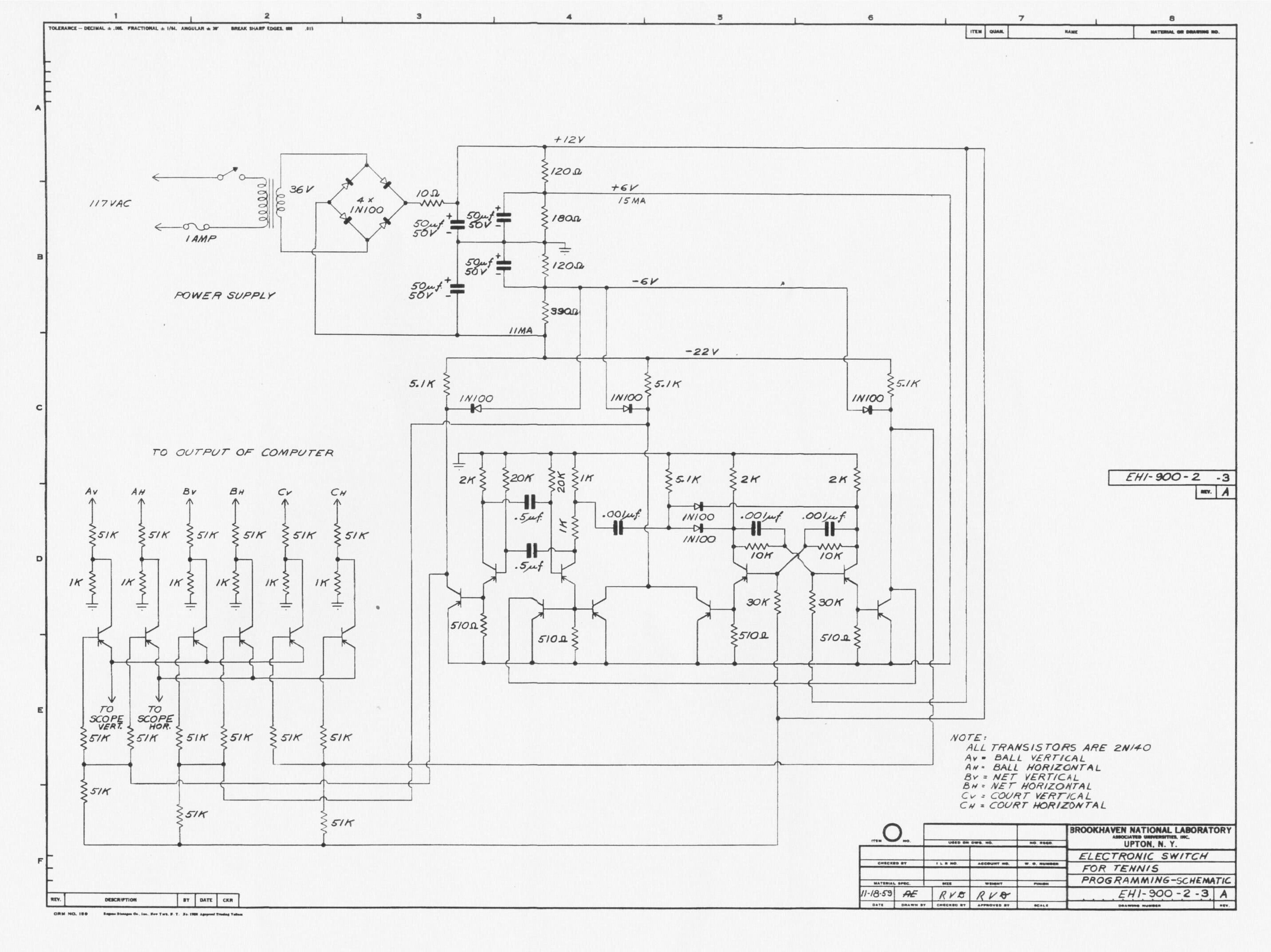
BNL · EH1-900-2-3 A · 18 November 1959
Three images.
One beam.
Ball, net and court connect to the oscilloscope in turn. The transistor network performs the switching; ngspice evaluates its voltages and transients.
Inputs and model
- Full model cycle
- —
- Historical reference
- 36 Hz
- A / B / C duty
- —
- Computation time
- —
Frequency follows component values and device models. No target 36 Hz clock is added.
Reconstructed network
The archival drawing supplies an astable multivibrator, differentiator, bistable divider, drivers and six analog keys. All 15 transistors are nonlinear PNP devices; switching arises in the circuit.
The standalone bench uses separate +12, +6, −6 and −22 V sources. Six inputs are test voltages; 60 Hz sweeps exercise the keys. Bench oscilloscope loading is 1 MΩ ∥ 30 pF.
Bounded mode retains the same network: 0.12 s window, maximum 50 µs step, reltol 10⁻⁴. Reference: 0.24 s, maximum 20 µs, reltol 10⁻⁶. The short run supports BF 50–100 and temperature 10–40 °C. Frequency, edge and settled X/Y errors are checked separately in the report.
Accuracy and model choices
RCA SC-11 gives typical small-signal gain 75 for 2N140 at one operating point. Remaining Ge SPICE parameters are preliminary and affect frequency and transfer distortion. This is a working network transcription with declared device models.
Transformer, rectifier, sweep-source internals and CRT physics are outside this standalone bench. The game can pass frozen U7/U2 outputs through the six transistor keys with the net/court test sweeps. In the playable instrument, computer, switch, passive supply and scope macromodel already share one transient analysis.
Model parameters and evidence · Connections, assumptions and scope · Full-size archival drawing